


FILE 026 | Acquisition by Osmosis?
- October 21, 2026
Who Really Owns the Technology Behind the CyberloQ Joint Venture?
The Bob Morales Files | October 21, 2026
Corporate announcements can describe technology portfolios, partnerships, and integration plans. But they cannot substitute for the agreements establishing who actually owns the intellectual property.
A Joint Venture Built on Whose Technology?
On October 2, 2026, CyberloQ Technologies announced a joint venture with Michigan Secure Capital Group Corp., the corporation associated with Robert “Bob” Morales and Jerry Rizqallah.
According to the announcement, the parties executed a 50/50 joint venture agreement on September 29, 2026.
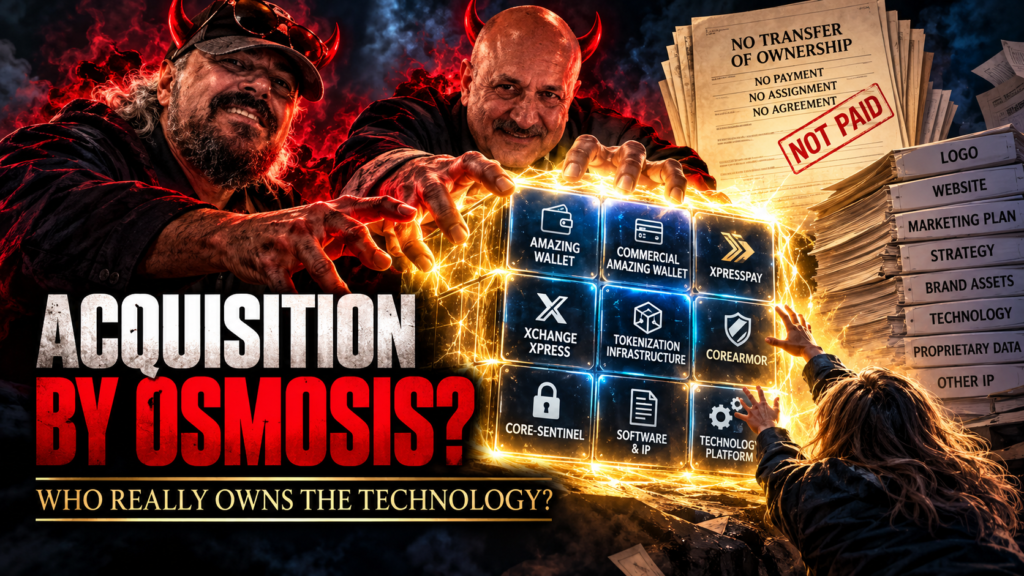
The announced technology portfolio included:
CoreArmor
Commercial Amazing Wallet
Amazing Wallet
XpressPay
XchangeXpress
Tokenization infrastructure
Core-Sentinel
Notably, CyberloQ’s announcement states that the corporation will make available certain approved technology rights, which may include the listed products and platforms. It does not state that the corporation owns every technology identified, nor does it establish that all listed technologies have already been contributed.
The announcement further specifies that each party retains ownership of its pre-existing intellectual property, with use and integration subject to approvals and licensing restrictions under the operating agreement.
The question is therefore not simply who developed these technologies, but what rights the corporation actually holds—and whether those rights authorize their proposed use within the joint venture.
On October 14, CyberloQ announced that technology integration had commenced.
Those announcements establish that a business arrangement was publicly presented and that integration activity was subsequently reported.
They do not, by themselves, establish the ownership history of the technologies involved.
The fundamental question is whether the Morales-led corporation possessed valid ownership, licensing, or other contractual rights sufficient to make these technologies available to the joint venture—and what executed agreements establish those rights.
Ownership, licensing, development, employment, and commercial distribution are different legal relationships.
A company may have authority to market or integrate technology without owning it. Conversely, access to a technology platform or the involvement of its developer does not automatically transfer ownership to the company.
The distinction matters when intellectual property forms part of the commercial foundation of a joint venture.
CoreArmor: A Separate Trademark Ownership Question
CoreArmor introduces an additional issue.
The CoreArmor trademark has been identified as belonging to CoreIntelligent, a business separate from the Morales-led corporation.
That distinction raises questions about the trademark designation appearing in the CyberloQ announcement and the rights under which CoreArmor is included in the joint venture.
Who owns the CoreArmor trademark, who owns the underlying technology, and what agreements authorize its inclusion in the venture?
Trademark ownership and software ownership are not necessarily the same. A trademark owner may license its mark, while software rights may be held under entirely separate arrangements.
If CoreIntelligent owns the relevant trademark, the appropriate questions are whether it authorized the use of the mark, whether the corporation obtained licensing or commercialization rights, and whether those rights extend to the announced joint venture.
A trademark symbol beside a product name does not identify the trademark owner or demonstrate that the corporation announcing the product owns it.
The relevant trademark records and executed agreements—not the presentation of a trademark designation in a press release—would establish the respective rights of the parties.
The Nicholas Mitchell Question: A $5 Million Acquisition
The documentary record raises a more specific question concerning Amazing Wallet.
Nicholas Mitchell was appointed Chief Technology Officer effective June 30, 2025.
His signed four-page appointment and compensation package provided for:
A $200,000 annual salary.
A 2% fully diluted equity interest, subject to a four-year vesting schedule and one-year cliff.
A 3% net revenue royalty on specified technology products.
Separate agreements addressing employment, intellectual-property assignment, equity, and royalties.
The distinction between an executive appointment and an intellectual-property acquisition is significant.
The signed CTO appointment is not, by itself, an executed purchase agreement transferring ownership of Amazing Wallet or other pre-existing technology to the corporation.
The corporation’s own executive planning records provide additional context.
An August 12, 2025 TATT executive meeting agenda specifically identified:
“$5MM – Purchase Amazing Wallet + Cryptocurrency – (Steve / Bob / Nicholas)”
The agenda also assigned Steve O’Brien and Bob Morales responsibility for completing the Amazing Wallet agreement.
This was not merely a passing reference to a product under development.
It was an identified acquisition item, with a stated $5 million purchase amount and named participants responsible for completing the agreement.
The records establish that an Amazing Wallet purchase was being pursued. They do not establish that the transaction closed.
The questions are therefore specific:
Was the purchase agreement executed?
What consideration was required, and was it paid?
Did ownership transfer immediately, through vesting, upon payment, or subject to other contractual conditions?
Which technologies and intellectual-property rights were included?
And what rights, if any, remained with Mitchell or the entities through which the technology was originally developed?
These questions can be answered through the purchase agreement, applicable assignments, payment records, and any subsequent amendments.
Until those documents are examined, the signed CTO appointment and executive agenda cannot be treated as proof of a completed $5 million acquisition.
Nicholas Mitchell’s Unexpected Termination Claim
On October 20, 2026, Nicholas Mitchell contacted the publisher of The Bob Morales Files and stated that he was no longer employed by the corporation.
He claimed that he had been terminated approximately one month earlier.
That statement has not been independently verified.
The timing nevertheless creates an important issue.
The joint venture was reportedly executed September 29, 2026.
If Mitchell’s employment ended approximately one month before his October 20 communication, his departure may have occurred near the period in which the venture was being finalized.
What was the status of the Amazing Wallet acquisition and associated technology rights at the time the joint venture agreement was executed?
Employment termination does not ordinarily reverse an otherwise valid, completed intellectual-property assignment. Nor does employment, by itself, establish ownership of an employee’s independently developed, pre-existing technology.
The controlling documents matter.
If the corporation acquired the technology before Mitchell’s departure, the purchase and assignment records should establish that.
If it instead held licensing or commercialization rights, those agreements should define the scope and duration of those rights.
And if ownership remained elsewhere, the joint venture documentation should explain the authority under which the technologies were included.
Whether Mitchell’s termination account proves accurate or not, the underlying ownership questions remain.
The Viral Solutions Record: More Than Three Years of Work, Invoices, and Delivered Intellectual Property
For Viral Solutions LLC, the question of whether the Morales-led corporation has properly acquired the intellectual property it uses is not theoretical.
It arises from more than three years of work performed, materials developed and delivered, invoices issued, and compensation that remains outstanding.
Viral Solutions’ position is supported by a substantial documentary record—not simply a disagreement about who deserves credit for creative work.
Through its work for the corporation, Viral Solutions developed and supplied branding, digital assets, website design, marketing materials, strategic recommendations, and other proprietary work product.
The work included a comprehensive marketing plan and materials delivered directly to Robert Morales in connection with the corporation’s operations, positioning, and proposed growth.
These were substantive professional services and business assets developed over an extended period.
The record includes invoices for work performed and compensation due.
The documentary record also includes a transcription of the November 11 meeting confirming that previously submitted budgets had been approved and increased. Those budgets included outstanding amounts owed to Viral Solutions LLC.
The work was performed. The materials were delivered. The invoices were issued. The outstanding amounts were included in budgets subsequently confirmed as approved and increased during the November 11 meeting. And the compensation remains unpaid.
Those facts are central to understanding the dispute.
This is not a situation in which Viral Solutions is attempting to establish that a business relationship existed.
The business relationship, the work performed, and the delivery of materials are documented.
The dispute concerns the corporation’s outstanding obligations and its assertions of ownership or control over intellectual property developed through that relationship.
The Ownership Issue
Viral Solutions asserts ownership of disputed creative and intellectual-property assets, including the corporate logo it developed, website design, and other proprietary marketing and digital materials.
The company has not executed a sale or assignment transferring ownership of those disputed assets to the corporation, according to its records.
Delivery of work product is not, by itself, an assignment of intellectual-property ownership.
The applicable agreements, the nature of the work, and the legal rights associated with each asset determine whether ownership or particular usage rights were conveyed.
The absence of a completed purchase or assignment is especially important where a corporation asserts that it owns assets developed by a separate business.
Viral Solutions’ records document its creation and delivery of the disputed materials and its efforts to obtain payment and resolve the ownership issues.
The company continues to retain and preserve those records.
Robert Morales and Jerry Rizqallah
Viral Solutions identifies both Robert Morales and Jerry Rizqallah as individuals involved in the unresolved corporate ownership and compensation matters.
Its account is based on its direct business dealings, communications, and the documentary history of the relationship.
The corporation received the benefit of work and materials supplied by Viral Solutions. Yet the outstanding compensation and disputed ownership issues have not been resolved.
The involvement of Morales and Rizqallah is relevant because these matters concern corporate decisions, representations, and obligations—not simply an unpaid invoice sitting in an accounting system.
The questions are straightforward.
Who authorized the use of the materials?
Who asserted that the corporation owned or controlled them?
What agreements were relied upon to support those assertions?
And why do the documented compensation obligations remain unresolved?
Those questions deserve direct answers from the individuals involved.
What Else Has Been Used?
The publicly visible dispute concerns identifiable assets, including branding and website-related intellectual property.
But Viral Solutions delivered considerably more than those visible assets.
Its work included strategic planning, marketing concepts, recommendations, positioning, and other materials capable of being incorporated into internal presentations, third-party proposals, business development activities, or future commercial arrangements.
Viral Solutions knows what it created and delivered.
What it cannot presently establish is the full extent to which the corporation has subsequently used, reproduced, distributed, adapted, or shared those materials outside the company’s view.
That distinction is important.
The creation and delivery of the materials are documented.
Their subsequent internal or third-party use requires further examination.
The corporation’s private records, presentations, communications, and business agreements may establish whether additional Viral Solutions work product has been incorporated into its activities.
The issue is therefore potentially broader than the visible logo and website dispute.
How much of the corporation’s business development, branding, and strategic presentation has relied on intellectual property created and supplied by Viral Solutions without a completed ownership transfer?
A Familiar Question Across Different Technology Assets
The Viral Solutions dispute and the questions concerning Nicholas Mitchell’s technology are not identical transactions.
They involve different assets, agreements, parties, and potential ownership arrangements.
But they raise the same fundamental question:
What documentation establishes the corporation’s right to claim, control, commercialize, or contribute intellectual property developed by another party?
In the Viral Solutions matter, the documentary record includes more than three years of work, delivered materials, unpaid invoices, and outstanding compensation included in budgets subsequently confirmed as approved and increased during the November 11 meeting.
In the Amazing Wallet matter, the records include a signed CTO appointment contemplating separate intellectual-property agreements and an executive agenda identifying a proposed $5 million acquisition.
In the CoreArmor matter, the question concerns independently held trademark rights and the contractual basis for including the technology in the joint venture.
Each situation requires examination of its own governing documents.
What cannot be assumed in any of them is that intellectual property automatically becomes corporate property because the corporation had access to it, employed its developer, received the work, or included it in a business announcement.
Corporate association is not ownership. Possession is not assignment. Access is not acquisition.
And announcing a joint venture does not cure gaps in the chain of title to the underlying intellectual property.
The Documents That Would Answer the Questions
The ownership issues raised in this investigation are capable of documentary resolution.
For Amazing Wallet and related technology, the relevant records include the completed purchase agreement, intellectual-property assignments, payment documentation, and any continuing royalty, licensing, or vesting arrangements.
For CoreArmor, the relevant records include trademark ownership information and any licensing, assignment, or commercialization agreements authorizing its inclusion in the venture.
For Viral Solutions, the relevant records include the work agreements, invoices, delivery history, correspondence, November 11 meeting evidence, and any document the corporation relies upon to claim ownership of the disputed materials.
For the CyberloQ joint venture, the critical records include the executed operating agreement, any applicable schedules identifying approved technologies, and the ownership, licensing, assignment, or commercialization agreements supporting each party’s contributions.
CyberloQ’s announcement expressly states that each party retains ownership of its pre-existing intellectual property. It also describes restrictions governing the use and integration of those technologies.
These provisions make the underlying chain of ownership and licensing particularly important. A right to access, develop, or market technology is not necessarily a right to sublicense it, contribute it to a joint venture, or authorize its use by another corporate entity.
That makes the ownership and licensing schedules especially consequential.
If the Morales-led corporation acquired the relevant rights, the executed agreements and supporting records should establish what it acquired, from whom, and under what conditions.
If the corporation holds licenses rather than ownership, those agreements should define what it is authorized to contribute.
The agreement also provides for CyberloQ to contribute 200 million shares of Class B Non-Voting Common Stock to the venture, subject to restrictions on their transfer, pledge, financing, or other disposition without CyberloQ’s prior written consent. CyberloQ may also require reconveyance of those shares following an uncured material breach under the agreement.
This adds another dimension to the importance of the venture’s contractual representations, performance obligations, and intellectual-property rights. The terms governing these contributions warrant examination alongside the underlying technology agreements.
The distinction is material to the businesses, developers, and investors affected by the venture.
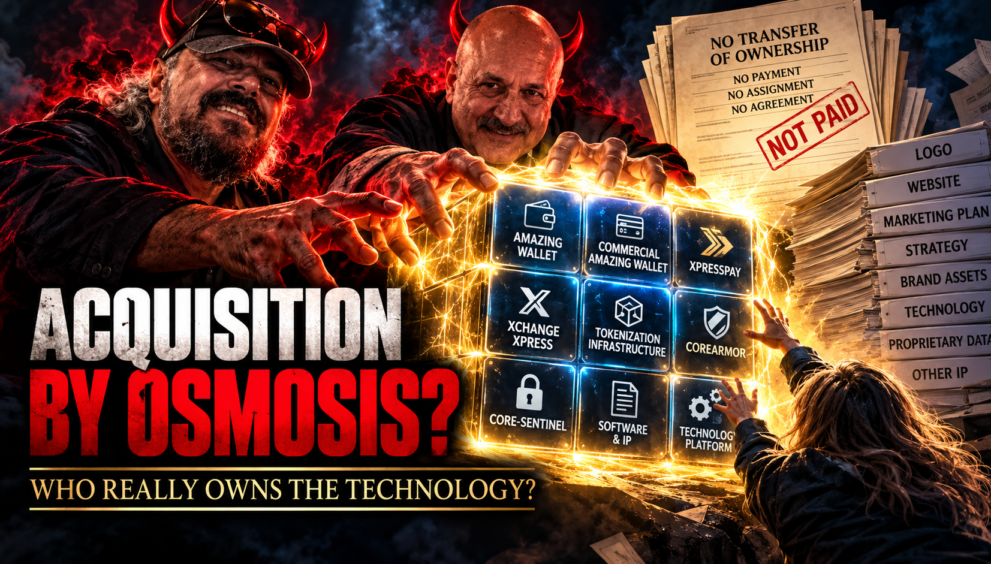
Acquisition by Osmosis?
The available records do not establish that the proposed $5 million Amazing Wallet acquisition was completed.
They do establish that such an acquisition was specifically contemplated and assigned for completion.
The signed CTO appointment does not substitute for the separate intellectual-property documentation it contemplated.
CoreArmor raises a separate question concerning trademark ownership and authorized use.
Viral Solutions’ experience provides a documented example of an extended commercial relationship involving substantial delivered work, unpaid invoices, outstanding amounts incorporated into approved budgets, and unresolved intellectual-property ownership issues.
These are not interchangeable circumstances.
But together, they demonstrate why the legal and commercial basis for claimed intellectual-property rights deserves examination.
A corporation does not acquire ownership simply by receiving work, employing a developer, announcing a partnership, or incorporating a product into its business plans.
Ownership must arise from an applicable legal right or agreement.
The question for the Morales-led corporation is whether the required rights were actually acquired—and whether the documentary record supports the representations being made.
Has the corporation properly acquired the intellectual property it claims to control?
Or is this another example of acquisition by osmosis?
The Bob Morales Files will continue examining the documentary record as additional evidence becomes available.
Corporate Identity Clarification
This investigation concerns the specific corporate entity identified in CyberloQ Technologies’ October 2026 joint venture announcement and associated with Robert Morales and Jerry Rizqallah.
It does not concern independently owned or operated businesses, websites, or digital properties that may use similar names or abbreviations. No ownership or operational affiliation between those independent properties and the corporation discussed here is implied.
Editor’s Note
This investigation draws upon corporate announcements, executive meeting records, contractual documentation, and Viral Solutions LLC’s records of more than three years of professional work, delivered materials, invoices, and communications.
The documentary record includes a transcription of the November 11 meeting confirming that previously submitted budgets had been approved and increased. Those submitted budgets included outstanding amounts owed to Viral Solutions LLC.
The questions remaining open concern the scope of subsequent use and asserted ownership of the disputed materials, the completion and terms of the technology acquisitions, the contractual rights underlying the CyberloQ joint venture, and Nicholas Mitchell’s unverified account of his employment termination.
The CoreArmor trademark ownership and licensing details should be confirmed against the applicable registration and agreements.
Author’s Note
As this investigation continues, an increasingly troubling question emerges: Is Viral Solutions LLC simply one of several businesses or individuals whose work, technology, and intellectual property have become entangled in the practices of the Morales-Rizqallah led corporation?
The questions surrounding Amazing Wallet, CoreArmor, and other technology assets suggest that Viral Solutions may not be alone in seeking answers about ownership, compensation, corporate ethics, and accountability.
If so, the issue extends far beyond one company’s unpaid invoices. It raises fundamental questions about the integrity of the individuals directing these transactions.