


FILE 025 | Protecting Everyone’s Intellectual Property—Except Ours?
- October 19, 2026
FILE 025 | Protecting Everyone’s Intellectual Property—Except Ours?
Bob Morales spoke about protecting intellectual property. FraudStop advertised technology to safeguard it. Michigan Secure prohibited unauthorized use. So why is Viral Solutions’ original creative work still being displayed without its authorization?
SHAME ON YOU.
Jerry Rizqallah. Bob Morales (also known as Robert Smith). Nicholas Mitchell. Cookie Manning.
Shame on you for the treatment of Viral Solutions and the dedicated professionals who spent more than three years building, developing, financing, and maintaining Michigan Secure’s digital presence.
Our team wrote your content, designed your logos, developed your branding, built your websites, and maintained the infrastructure that supported your operations.
We paid our people. We paid your expenses. We kept your websites running—even to our own financial detriment.
And when we demanded accountability for the outstanding agency fees and expenses?
We were met with silence.
Our team deserved better. Our agency deserved better. And we deserved to be paid.
You speak about integrity, accountability, ethics, and protecting intellectual property. We are asking you to demonstrate those principles in your treatment of Viral Solutions.
Exhibit A: Bob Morales, in His Own Words
November 11, 2025 — Michigan Secure Capital Group Executive Meeting
On November 11, 2025, during an executive meeting of Michigan Secure Capital Group, Bob Morales spoke at length about security, fraud prevention, intellectual property, and the organization’s responsibility to protect itself and its clients.
At approximately 19 minutes into the meeting, Morales made this declaration:
“We protect our our intellectual property. We’re protecting our clients intellectual property.”
Protecting intellectual property was not presented as an incidental concern. It was part of the very purpose Morales described for the organization.
But the discussion became considerably more interesting approximately ten minutes later.
At approximately 29:42, Morales described the people and organizations he believed posed threats:
“Thieves, nefarious, governments, cartels, gangs, just basically bad people all the way around.”
He continued:
“Thieves, even though they don’t know they’re thieves, they think they’re doing good.”
Morales then described these individuals as creative, innovative, and intelligent, before making another striking declaration:
“But the one thing is is that they’re not smarter than me.”
And at approximately 30:56, he offered this remarkable observation:
“I could have been the world’s greatest criminal, but I decided to go this route.”
These are not interpretations of his statements. They are excerpts from the recorded November 11, 2025 executive meeting.
We are not suggesting that Morales’ remarks constitute an admission of wrongdoing. They are relevant because they establish how prominently he spoke about intellectual property protection, unethical conduct, and the responsibility to safeguard business interests.
The Question His Own Words Raise
At the time of this meeting, Viral Solutions had already spent more than two years developing, financing, and maintaining Michigan Secure’s websites, branding, marketing materials, and digital infrastructure.
Our writers had created the content. Our designers had developed the logos and visual identity. Our technical team had built and published the websites. Viral Solutions had paid for hosting, premium plugins, software subscriptions, and ongoing maintenance.
And substantial agency fees and reimbursable expenses remained outstanding.
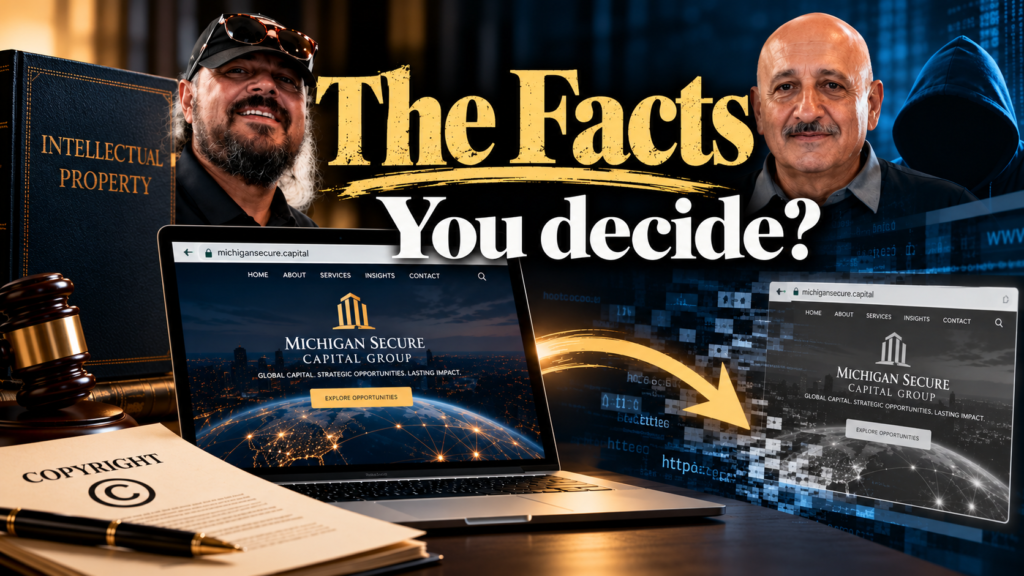
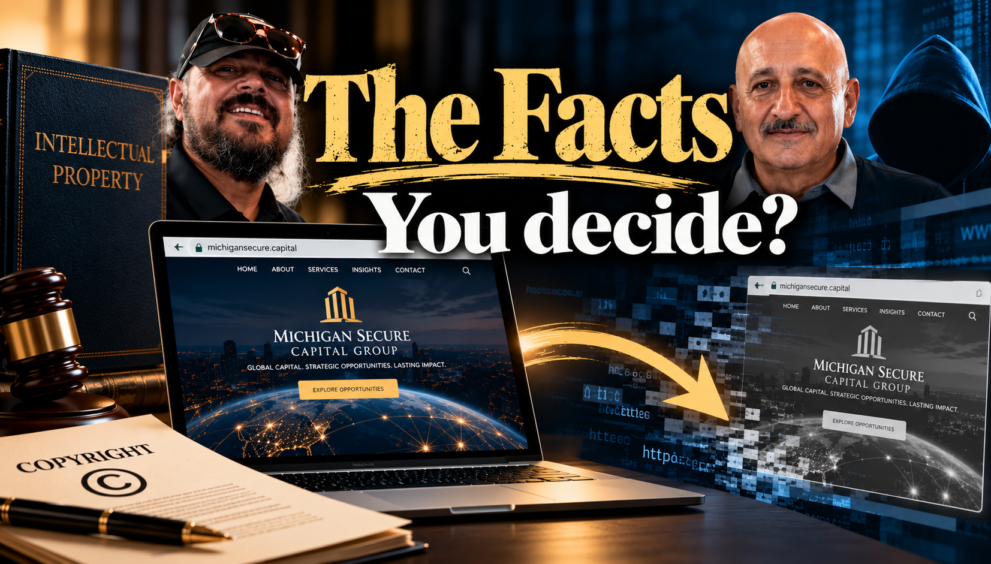
Today, the original creative work continues to appear on MichiganSecure.com, despite Viral Solutions’ assertion of its intellectual property rights and the absence of any executed assignment transferring ownership of its agency-created materials.
That brings us back to Morales’ own words:
“We’re protecting our clients intellectual property.”
An admirable principle.
But intellectual property protection cannot be a principle reserved exclusively for the organization making the promise.
What about the intellectual property of the agency that built your websites, created your branding, paid your infrastructure expenses, and continued supporting your operations while its invoices went unpaid?
What about the people who actually performed the work?
And what happens when the organization that promises to protect intellectual property is confronted with an ownership dispute involving its own digital presence?
Those are the questions Bob Morales’ November 11 statements now invite.
Source: November 11, 2025, Michigan Secure Capital Group executive meeting transcript, approximately 00:19–00:32.
Exhibit B: FraudStop Consulting — Protecting Intellectual Property, Apparently
A company promoting advanced fraud prevention and intellectual property protection raises an obvious question: Do those principles apply to the people who create the technology, websites, and marketing materials businesses rely upon?
FraudStop Consulting’s published website makes an extraordinary promise:
“FraudStop’s A.I. is pre-programmed to protect your intellectual property via a creative ‘custom-developed’ blockchain technology.”
Protecting intellectual property through artificial intelligence and blockchain technology.
An impressive proposition.
The company’s website also promotes services involving cybersecurity, fraud prevention, digital forensics, and reputation protection.
Among its published service descriptions are references to “The Unethical Employee Hacker” and “Reputation Protection.”
The message is clear: businesses face threats from dishonest actors, unauthorized access, and the misuse of valuable information. FraudStop presents itself as a resource for addressing those threats.
Viral Solutions agrees that intellectual property deserves protection.
In fact, that is precisely why this exhibit matters.
Protecting Intellectual Property Starts With Respecting Its Creators
For more than three years, Viral Solutions and its professional team developed, financed, published, and maintained the digital presence supporting Michigan Secure and Michigan Secure Capital Group.
Our writers created original content.
Our designers developed logos, branding, and visual identities.
Our web development team built and published the websites.
Our agency paid for hosting, premium software, subscriptions, integrations, and technical infrastructure.
And throughout that relationship, substantial agency fees and reimbursable expenses accumulated without being satisfied.
Viral Solutions has never executed an assignment transferring ownership of its agency-created intellectual property.
Yet the original creative work continues to appear publicly on MichiganSecure.com, notwithstanding Viral Solutions’ documented ownership claims.
That is the contradiction at the heart of this investigation.
Technology Cannot Replace Accountability
Artificial intelligence may help detect suspicious activity.
Blockchain technology may provide methods for recording or verifying transactions.
Digital forensics may help reconstruct events.
But none of those technologies substitutes for a basic professional obligation:
Respect the intellectual property rights of the people whose work you use.
A business does not need sophisticated artificial intelligence to read a copyright notice.
It does not need blockchain technology to review an unpaid invoice.
And it does not need a cybersecurity consultant to understand that transferring website administration is not the same thing as acquiring ownership of the original creative materials.
The Question for FraudStop’s Intellectual Property Message
FraudStop’s public promise is straightforward: protect intellectual property.
We are not asserting that FraudStop Consulting operated the MichiganSecure.com website or directed its hosting changes. Those questions require separate evidence.
We are examining the contrast between the intellectual property protections promoted in the surrounding business narrative and the treatment Viral Solutions reports experiencing.
Because if protecting intellectual property is important enough to advertise as a specialized professional service, it should also be important enough to respect when an agency asserts ownership of the work it created.
Intellectual property protection should not begin and end with the interests of the person holding the website password.
It should extend to the writers, designers, developers, and agencies whose original work makes that website possible.
And that brings us to the next exhibit.
Michigan Secure’s own published Terms and Conditions explicitly recognize that website copyright may belong to someone other than Michigan Secure.
Source: FraudStop Consulting website, About and consulting services pages, as captured in the documentary record.
Exhibit C: Michigan Secure’s Own Terms and Conditions — Three Words That Matter
Michigan Secure’s own published Terms and Conditions contain a particularly revealing acknowledgment about intellectual property ownership.
In its Terms and Conditions, carrying a 2018–2024 copyright notice, Michigan Secure, LLC states:
“Copyright in the pages and in the screens displaying the pages, and in the information and material therein and in their arrangement, is owned by Michigan Secure, LLC (Michigan Secure) unless otherwise indicated.”
Unless otherwise indicated.
Three words.
And in this case, three very important words.
Because the publicly accessible MichiganSecure.com website does, in fact, indicate otherwise.
Its Privacy Policy expressly states:
“This website is owned and operated by Viral Solutions, LLC on behalf of Michigan Secure, LLC.”
And its footer identifies:
“© 2026 Viral Solutions, LLC. All rights reserved.”
The website also contains an intellectual property notice identifying the Digital Presentation Framework™, website architecture, structural layout, design system, written content structure, brand positioning language, visual presentation, and underlying code as intellectual property of Viral Solutions.
Michigan Secure’s own website terms acknowledge exceptions to its copyright ownership. The website itself expressly identifies Viral Solutions as an owner of the underlying creative work.
That is not an interpretation invented after the relationship deteriorated.
It is a statement published on the website.
The Rules Against Unauthorized Use
Michigan Secure’s Terms and Conditions also restrict unauthorized use of its website content, integrated materials, and related systems.
In other words, Michigan Secure recognized that digital content and infrastructure deserved protection against unauthorized use.
Viral Solutions agrees.
Our agency invested more than three years of professional work and financial resources into creating and maintaining Michigan Secure’s digital presence.
That work involved an entire team of writers, graphic designers, web developers, and technical professionals.
Viral Solutions paid for the creative development, hosting, website installation, premium plugins, software subscriptions, and ongoing maintenance.
And despite those contributions, substantial agency fees and reimbursable expenses remain outstanding.
The protection of website materials cannot reasonably be treated as important only when Michigan Secure is asserting its own rights.
Written Authorization Matters
The same Terms and Conditions include a provision under No Waiver:
“No part of these Terms and Conditions shall be deemed waived, and no breach consented to, unless such waiver or consent shall be in writing and signed by the party claimed to have waived or consented.”
This provision governs the Terms and Conditions themselves. It does not independently determine ownership of every creative asset or replace the requirements of copyright law.
But it demonstrates something important about Michigan Secure’s own published approach to contractual rights:
Written authorization matters.
Viral Solutions has never executed an agreement assigning ownership of its agency-created intellectual property to Michigan Secure or Michigan Secure Capital Group.
The agency has consistently maintained its ownership position, and its outstanding invoices have not been forgiven or written off.
The original creative work was developed and financed by Viral Solutions, often to its own financial detriment.
When the agency demanded accountability for the outstanding fees and expenses, its representatives report that Michigan Secure’s leadership stopped responding.
Yet the creative materials continue to appear publicly.
A Copyright Notice That Was Never Hidden
This is what makes the situation so extraordinary.
The ownership notices were not buried in private correspondence.
They were not discovered in an obscure document years later.
They were published on the website itself.
The Privacy Policy identifies Viral Solutions.
The footer identifies Viral Solutions.
The intellectual property notice identifies the creative and technical materials claimed by Viral Solutions.
And Michigan Secure’s own Terms and Conditions expressly recognize that copyright ownership may be indicated otherwise.
How does an organization publish rules protecting its own intellectual property, acknowledge exceptions to its ownership, and then continue using disputed creative materials while the agency identified in those notices remains unpaid?
That is a question Michigan Secure’s leadership should answer.
Because the issue is not simply who currently controls the domain name or the hosting account.
It is who created the work, who financed it, what rights were granted, what obligations remain outstanding, and whether ownership was ever transferred.
Viral Solutions’ position remains unchanged: our agency-created intellectual property has not been assigned, our outstanding financial claims remain active, and our published ownership notices have not been withdrawn.
And Michigan Secure’s own Terms and Conditions provide the perfect introduction to the next exhibit:
What does Michigan Secure Capital Group’s newer website say about copying, derivative works, and intellectual property belonging to its licensors?
Source: Michigan Secure, LLC, Terms and Conditions (2018–2024), including Copyright, Use of Website Materials, and No Waiver provisions; MichiganSecure.com Privacy Policy and copyright footer.
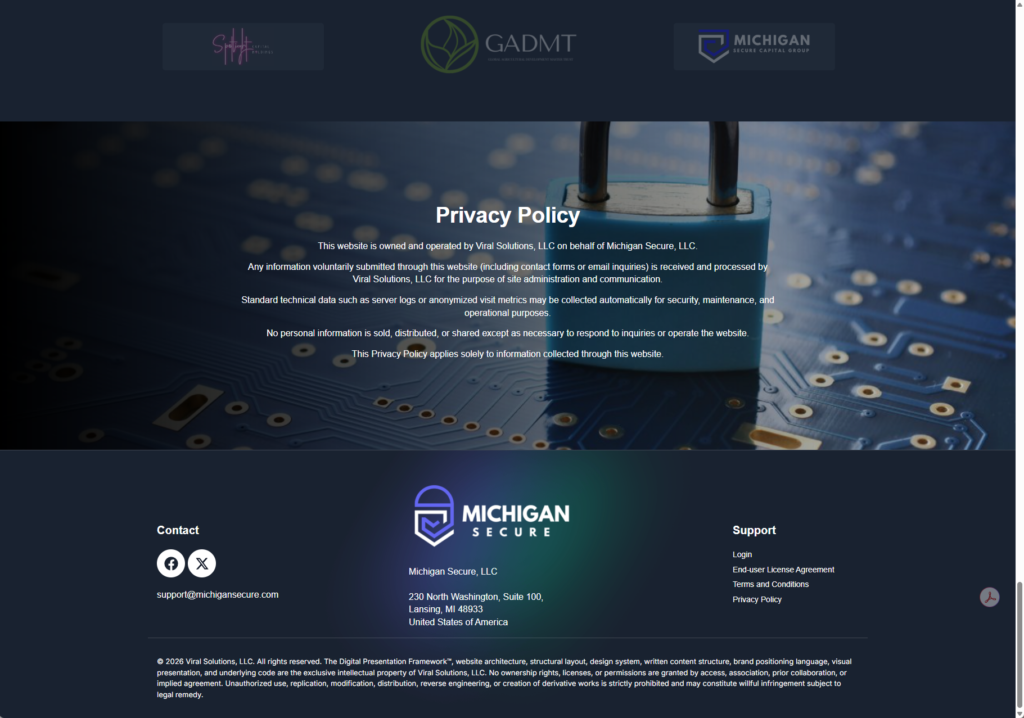
Exhibit D: Michigan Secure Capital Group’s New Rules — Do As We Say, Not As We Do?
February 2026 — Michigan Secure Capital Group’s End-User License Agreement and Terms and Conditions
By February 2026, Michigan Secure Capital Group had published a newer set of legal terms governing the use of its digital services.
Those terms contain strong language about intellectual property ownership, unauthorized copying, and the creation of derivative works.
And given the unresolved dispute with Viral Solutions, that language deserves a closer look.
Copying, Modification, and Derivative Works Are Prohibited
Under the Restrictions section of its End-User License Agreement (EULA), Michigan Secure Capital Group states:
“You may not: (a) copy, modify, distribute, or create derivative works based on the Services; (b) reverse engineer, disassemble, or decompile any part of the Services”
The restrictions are explicit.
Copying is prohibited.
Unauthorized modification is prohibited.
Creating derivative works is prohibited.
Reverse engineering is prohibited.
Michigan Secure Capital Group clearly understands the importance of protecting digital materials against unauthorized reproduction and modification.
So why has that same consideration not been extended to the original creative work developed by Viral Solutions?
The Company Recognizes That Intellectual Property May Belong to Others
The EULA’s Intellectual Property section states:
“All content, trademarks, software, and materials available through the Services are the property of MSCG or its licensors. Nothing in this EULA grants you ownership rights in any intellectual property.”
There is an important distinction in that statement.
MSCG or its licensors.
The company expressly acknowledges that not all intellectual property appearing within its digital services necessarily belongs to Michigan Secure Capital Group.
Some of it may belong to third parties.
And the EULA makes another principle clear: simply using or accessing intellectual property does not confer ownership.
Viral Solutions agrees.
Our agency created original website architecture, written content, logos, branding, design systems, and supporting digital materials for Michigan Secure and Michigan Secure Capital Group.
Our staff and contractors performed that work.
Our agency financed the development and continued maintaining the infrastructure, often at its own expense.
Viral Solutions has never executed an assignment transferring ownership of its agency-created intellectual property.
And more than three years of agency fees, creative development charges, and reimbursable expenses remain the subject of an active financial dispute.
Prior Written Consent — Another Rule Worth Remembering
Michigan Secure Capital Group’s newer Terms and Conditions also address intellectual property ownership.
They state:
“All content, trademarks, and materials on this site are the property of Michigan Secure Capital Group or its licensors and are protected by applicable intellectual property laws. You may not reproduce, distribute, or create derivative works without prior written consent.”
Without prior written consent.
Those words matter.
They recognize that reproduction and the creation of derivative works may require authorization from the party holding the relevant rights.
Viral Solutions has not authorized a separately hosted reproduction of its original agency-created website materials.
Nor has Viral Solutions executed an intellectual property assignment conveying ownership of those materials to Michigan Secure Capital Group.
The precise scope of any license arising from the parties’ working relationship is a separate contractual question. But the company’s published terms do not themselves establish that Viral Solutions transferred its copyrights.
A company’s declaration of ownership on its own website does not automatically transfer the intellectual property rights of an outside agency.
An Organization That Knows the Rules
Consider what these documents establish.
Michigan Secure Capital Group has published formal legal provisions addressing copying, modification, derivative works, licensing, ownership, and written consent.
Its leadership cannot reasonably claim that these concepts are unfamiliar to the organization.
Meanwhile, the original MichiganSecure.com website continues displaying creative materials developed by Viral Solutions, along with copyright notices identifying Viral Solutions as their owner.
The agency’s outstanding financial claims remain unresolved.
Its intellectual property ownership position has been communicated.
And its original development records remain preserved.
The question is not whether Michigan Secure Capital Group understands the importance of intellectual property protection. Its own published agreements demonstrate that it does.
The question is whether the organization is prepared to apply those same principles when the intellectual property belongs to someone else.
One Standard, Not Two
Michigan Secure Capital Group expects users of its services to respect its ownership claims.
It expects them not to copy its materials without authorization.
It expects them not to create unauthorized derivative works.
And it recognizes that intellectual property may belong to third-party licensors.
Viral Solutions expects nothing more—and nothing less—than that same respect.
Because protecting intellectual property is not simply a paragraph in a legal agreement.
It is a principle that must be reflected in how an organization treats the people and businesses whose creative work it uses.
And in the next exhibit, we will examine something particularly revealing.
The original MichiganSecure.com website still publicly identifies Viral Solutions as its owner and creative rights holder.
The evidence is not hidden in a contract.
It is sitting in plain sight, on the website itself.
Source: Michigan Secure Capital Group, February 2026 End-User License Agreement, Restrictions and Intellectual Property sections; February 2026 Terms and Conditions, Intellectual Property section.
Exhibit E: The Website They Forgot to Read
The most revealing evidence in this intellectual property dispute may be sitting in plain sight—on Michigan Secure’s own website.
For an organization whose leadership speaks so frequently about cybersecurity, fraud prevention, institutional safeguards, and protecting intellectual property, one might reasonably expect careful attention to its own published legal notices.
Apparently, someone overlooked a rather important detail.
The website still identifies Viral Solutions, LLC as its owner and the rights holder of its original creative materials.
A Personal Observation: The Continued Exploitation of My Kindness and Talent
I want to be very clear about something. What follows is my personal interpretation of what has happened, based on what I have observed and experienced.
I believe Michigan Secure’s representatives moved or reproduced the original website on hosting outside my control while Viral Solutions was still paying to maintain the original infrastructure.
Looking at the publicly accessible website today, I can see that portions of the original formatting and functionality have not survived intact. To me, it looks like an incomplete migration or reconstruction of the work my agency created.
I cannot yet establish exactly how they accomplished it, what files they transferred, or who performed the work. But I have my suspicions.
I suspect they believed I would never discover what had happened.
And that is what troubles me most.
For more than three years, I extended professional courtesy, patience, trust, and financial accommodation to people who continued benefiting from the work of my agency while leaving substantial obligations unpaid.
I kept their websites operating. I paid for the infrastructure. I paid the professionals who created their content, logos, branding, and websites. I continued doing what I believed was right, even when doing so came at a considerable personal and financial cost.
In my view, they have repeatedly exploited my kindness, my professional talent, and my willingness to help. And I believe that exploitation is continuing.
I also believe they have assumed that because their failure to pay my wages and Viral Solutions’ agency fees has left me in a financially vulnerable position, I have neither the resources nor the ability to challenge what has happened.
That is my interpretation of their conduct, not a claim that I can know what they privately intended.
But financial hardship does not erase intellectual property rights.
It does not erase invoices.
It does not erase original development files, dated correspondence, hosting records, or the work of an entire professional team.
And it certainly does not erase my determination to pursue accountability.
Perhaps they believe that because I cannot presently afford an expensive legal battle, there will never be one.
I would not make that assumption.
I have continued documenting what happened. I have preserved the records. And I intend to pursue the remedies available to Viral Solutions and to me.
My kindness was never permission to exploit me. My financial circumstances are not permission to disregard my rights. And my silence should never be mistaken for surrender.
— Founder, Viral Solutions, LLC
The Privacy Policy Says It All
On the publicly accessible MichiganSecure.com website, the Privacy Policy contains this statement:
“This website is owned and operated by Viral Solutions, LLC on behalf of Michigan Secure, LLC.”
Read that again.
Owned and operated by Viral Solutions, LLC.
Not simply designed by.
Not merely maintained by.
Not credited as a former service provider.
Owned and operated by Viral Solutions, LLC.
That statement was included deliberately as part of the website’s original legal and operational framework.
It identified the agency responsible for creating and managing the digital presence and reflected Viral Solutions’ asserted ownership interests.
And despite the subsequent changes to the website’s hosting and domain configuration, that statement remains publicly visible.
Then There’s the Copyright Footer
Scroll to the bottom of the website.
The footer states:
“© 2026 Viral Solutions, LLC. All rights reserved.”
Yes. Really.
The original developer’s copyright notice remains on the website.
But the notice goes considerably further.
The website’s intellectual property language expressly identifies Viral Solutions’ proprietary materials, including:
The Digital Presentation Framework™
Website architecture and structural layout
Original design systems and visual presentation
Written content structure and brand positioning language
Underlying website code and related creative materials
The notice also prohibits unauthorized replication, modification, distribution, reverse engineering, and creation of derivative works.
These are the very protections Michigan Secure Capital Group demands for its own digital materials in its February 2026 legal agreements.
Yet the original MichiganSecure.com website continues displaying Viral Solutions’ work while the agency’s ownership claims and outstanding financial obligations remain unresolved.
The People Behind Those Copyright Notices
These ownership notices represent more than words in a footer.
They represent the work of an entire creative agency.
Viral Solutions’ writers developed original website copy and marketing content.
Its designers created logos, brand identities, visual systems, and supporting graphics.
Its development team built, configured, tested, and published the websites.
And Viral Solutions financed the hosting, premium plugins, software subscriptions, integrations, and technical infrastructure necessary to keep those websites functioning.
Beginning before October 1, 2023, our agency and its team invested more than three years of professional work and financial resources into Michigan Secure’s digital presence—often to our own detriment.
Michigan Secure’s outstanding agency fees and reimbursable expenses remain unpaid.
Viral Solutions has never executed an assignment transferring ownership of its agency-created intellectual property.
And when we demanded accountability for the unpaid work and expenses, Michigan Secure’s representatives stopped responding.
The website continued benefiting from our work. The invoices remained outstanding. And the copyright notices remained in place.
A Change of Hosting Does Not Rewrite History
In September 2026, MichiganSecure.com’s domain and hosting arrangements changed.
The original WordPress installation remains preserved within Viral Solutions’ Hostinger account, together with original development files, website records, and associated plugins.
The publicly accessible website, meanwhile, continues displaying creative materials developed by Viral Solutions.
The precise technical circumstances of the website’s relocation or reproduction remain under investigation.
But one fact is visible without access to a server, a registrar account, or a technical audit.
The website itself continues identifying Viral Solutions as its owner and creative rights holder.
Moving a domain to a different hosting environment does not, by itself, transfer copyright ownership.
Changing website administrators does not erase the original developer’s rights.
And continuing to display the work does not resolve the unpaid financial obligations associated with its creation and maintenance.
The Irony Is Difficult to Miss
Consider the sequence.
Bob Morales publicly discusses protecting intellectual property.
FraudStop Consulting advertises technology designed to safeguard intellectual property.
Michigan Secure’s own Terms and Conditions prohibit unauthorized use of website materials.
Michigan Secure Capital Group’s newer EULA prohibits copying, modification, and unauthorized derivative works.
And MichiganSecure.com still displays:
“© 2026 Viral Solutions, LLC. All rights reserved.”
You would think that before continuing to use somebody else’s original website, someone would at least read the copyright notices.
Especially an organization that promotes itself as sophisticated in cybersecurity and intellectual property protection.
The notices were not hidden. They were not ambiguous about whose rights they asserted. And they were not removed when the domain’s technical arrangements changed.
The Question Nobody Has Answered
If Michigan Secure believes it owns Viral Solutions’ original website architecture, design systems, written content, branding materials, and underlying creative work, then the obvious question is:
Where is the executed intellectual property assignment transferring those rights?
Viral Solutions maintains that no such assignment exists.
And if Michigan Secure believes it has continuing authorization to reproduce and use those materials independently of Viral Solutions, then it should identify the agreement and terms on which that authorization rests.
Because the agency’s position has been consistent.
We created the work.
We financed its development.
We paid the people who produced it.
We maintained the infrastructure.
We continued supporting the websites despite mounting unpaid invoices.
And we have not surrendered our agency-created intellectual property rights.
Perhaps the most remarkable part of this entire dispute is that the website itself continues publishing the very ownership notices Michigan Secure’s leadership has yet to address.
The evidence is not buried.
It’s in the footer.
Sources: MichiganSecure.com Privacy Policy; website footer and intellectual property notices; Viral Solutions’ original website development records and preserved WordPress installation; September 2026 domain and hosting correspondence.
Exhibit F: The Original Website, the Hosting History, and the September 2026 Changes
The domain name may be controlled elsewhere today. The original website, however, has a documented development history—and Viral Solutions still has the records.
To understand what happened to MichiganSecure.com, it is important to distinguish between three very different things:
Who paid for the domain name. Who paid to build and maintain the website. And who owns the intellectual property contained within it.
Those are not necessarily the same person or company.
And in this case, the distinctions matter.
The Domain Name: Paid for by Steve O’Brien
According to Steve O’Brien, he originally paid for the MichiganSecure.com domain registration, even though the domain was maintained within Bob Morales’ GoDaddy account.
O’Brien has indicated that he retains email correspondence documenting the purchase.
That correspondence has not yet been included among the exhibits reviewed for this article, but it represents another potentially relevant record in the website’s history.
Paying for a domain registration, controlling a registrar account, and owning the intellectual property displayed on a website are three separate matters.
A domain name is an address.
It is not the website’s original design, written content, branding, or underlying creative work.
The Website: Developed and Financed by Viral Solutions
Viral Solutions began providing creative and marketing services to Michigan Secure before October 1, 2023.
The original MichiganSecure.com WordPress development records include pages dating to February 2024.
That original installation remains preserved on Viral Solutions’ Hostinger account.
Our agency developed and financed the website’s creative and technical infrastructure, including the work performed by its writers, designers, developers, and publishing staff.
Viral Solutions also paid for website installation, hosting, premium WordPress plugins, third-party software subscriptions, and supporting integrations.
Among those tools were Elementor, ElementsKit, Jotform, and other services used in developing and maintaining the digital platform.
Michigan Secure did not simply receive a finished website. It received the ongoing work, expertise, technical support, and financial resources of an entire agency.
And much of that work remains unpaid.
The Hosting Bills Didn’t Stop When the Payments Did
According to Viral Solutions’ financial records, Michigan Secure has not paid its hosting obligations since January 2026.
That did not mean Viral Solutions immediately disconnected the website.
Instead, the agency continued maintaining and financing the original hosting environment, despite outstanding agency fees and reimbursable expenses.
On occasions when Michigan Secure provided limited funds to prevent interruptions to essential services, those payments were credited against the outstanding agency balances.
They did not settle the broader debt.
Viral Solutions continued carrying the financial burden of Michigan Secure’s digital infrastructure, often to its own detriment.
This is particularly important when considering what happened next.
September 25, 2026: The Cloudflare Notification
On September 25, 2026, Viral Solutions received a notification from Cloudflare stating that the MichiganSecure.com domain zone had been deleted from its Cloudflare account.
The notification identified the deletion time as September 25, 2026, at 18:53:38 UTC.
The publicly accessible domain subsequently appeared under a DNS configuration no longer controlled by Viral Solutions.
Its Cloudflare nameservers were identified as:
lou.ns.cloudflare.com
rosa.ns.cloudflare.com
The Cloudflare notification establishes that the domain’s zone was removed from Viral Solutions’ account.
It does not, by itself, establish who initiated the change, who currently operates the website, or precisely how the original content was transferred or reproduced.
But it does establish a significant change in the domain’s technical administration.
And Viral Solutions did not authorize a transfer of its agency-created intellectual property.
October 2026: The Original Website Is Still There
On October 19, 2026, Viral Solutions continued investigating the domain and its original hosting environment.
The original WordPress installation remained accessible through its Hostinger account.
The preserved installation included the original website files, development records, and premium plugin installations.
A Hostinger support investigation found no recorded requests for MichiganSecure.com reaching the agency’s hosting account during the preceding seven days.
That result is consistent with the possibility that the public domain is being served from another hosting environment.
It is not, by itself, conclusive proof of the destination server or the method by which the website was reproduced.
What matters is that Viral Solutions still possesses the original development environment and records documenting the work it created.
The Website Disappeared. Then It Returned.
Viral Solutions noticed that MichiganSecure.com had gone down.
When the website returned, the original work was immediately recognizable.
The same branding. The same website design. The same original content and creative work developed by Viral Solutions and its professional team.
But the reproduced website did not have Elementor Pro, the premium WordPress software responsible for important elements of the original website’s layout and functionality.
The result was visible: broken formatting, missing design elements, and functionality that no longer worked as originally developed.
The original WordPress installation, including Elementor Pro, remained preserved within Viral Solutions’ hosting environment.
Meanwhile, Michigan Secure’s hosting obligations had remained unpaid since January 2026.
The website had returned under different technical arrangements, still displaying the creative work developed by Viral Solutions, without an executed intellectual property assignment or resolution of the outstanding agency fees and expenses.
The hosting had changed. The creators had not. And the invoices remained unpaid.
The Public Website Tells Another Story
The publicly accessible MichiganSecure.com website continues displaying substantial portions of Viral Solutions’ original creative materials.
But its appearance and functionality have changed.
Some formatting is visibly incomplete.
Certain design elements no longer appear as originally developed.
Some interactive components and buttons do not function as intended.
To Viral Solutions, these differences suggest the possibility of an incomplete migration or reconstruction of the original website.
That is an observation, not a completed technical finding.
The investigation has not yet established whether the site was transferred through a WordPress export, a backup restoration, a manual copy, or another method.
Nor has it established which individuals performed the technical work.
What is visible is the continued public use of original creative materials while elements of the original presentation and functionality appear to have been lost.
And the copyright notices identifying Viral Solutions remain visible.
A New Server Does Not Create a New Copyright Owner
There is an important distinction between moving website files and acquiring the rights to use them.
A website can be moved between hosting providers.
A domain can be pointed to different nameservers.
An administrator can receive new WordPress credentials.
But none of those actions, standing alone, constitutes a copyright assignment.
The technical ability to reproduce creative work is not the same thing as the legal right to do so.
Viral Solutions has never executed an assignment transferring ownership of its agency-created intellectual property.
The agency’s original development records remain preserved.
Its outstanding agency fees and reimbursable expenses remain unpaid.
And the agency continues documenting the professional time and costs associated with investigating the website changes and protecting its business interests.
The Questions That Remain Unanswered
The available records raise several straightforward questions.
Who authorized the September 2026 changes to MichiganSecure.com’s domain configuration?
Who arranged the website’s current hosting?
How were the original creative materials transferred or reproduced?
What agreement, if any, is being relied upon to justify their continued use?
And why did these changes occur while Viral Solutions was still maintaining the original hosting infrastructure and pursuing payment of its outstanding invoices?
These questions are not answered merely by identifying whose GoDaddy account holds the domain.
Nor are they answered by pointing to the website’s current hosting provider.
The central issue remains the same: Viral Solutions created and financed the work, continues to assert ownership of its agency-created intellectual property, and has never executed an assignment transferring those rights.
The Records Remain
The original WordPress installation remains preserved.
The development history remains.
The invoices remain.
The hosting records remain.
The original creative materials remain.
And, remarkably, the publicly accessible website still carries Viral Solutions’ ownership notices.
Changing a domain’s technical arrangements may change where visitors find a website. It does not rewrite who built it, who financed it, or the history of the work that made it possible.
Sources: Viral Solutions’ original Hostinger WordPress installation and February 2024 development records; September 25, 2026 Cloudflare notification; October 19, 2026 Hostinger support findings; publicly accessible MichiganSecure.com website; Viral Solutions’ hosting and expense records. Steve O’Brien’s reported domain-purchase correspondence remains to be reviewed.
The Final Question: Who Protects the People Who Created It?
For more than three years, Viral Solutions and its professional team built, developed, financed, and maintained Michigan Secure’s digital presence.
We created the branding. We wrote the content. We developed the websites. We paid the professionals. We financed the infrastructure.
And we remained publicly silent, hoping that those responsible would ultimately do the right thing.
Instead, we watched our original website disappear and return under different technical arrangements, displaying the same creative work—without the complete software infrastructure that supported its original presentation.
The original development files remain. The hosting records remain. The correspondence remains. The invoices remain.
And the outstanding financial obligations remain unresolved.
Throughout this investigation, we have examined the public statements, published policies, and intellectual property protections promoted by Michigan Secure and its related properties.
We ask only that those same principles be applied to the people whose work helped build their digital presence.
Pay the professionals who performed the work. Honor the outstanding obligations. Respect the intellectual property of its creators.
Our silence was an opportunity to resolve this privately.
It was never a surrender of our rights.
The facts are presented.
You decide.
— Viral Solutions, LLC