




File 020 | Sometimes Marketers Shouldn’t Fix Their Clients’ Words
- August 30, 2026
Sometimes Marketers Shouldn’t Fix Their Clients’ Words
A Marketer’s Dilemma: What happens when the words you’re directed to publish are the very words you believe shouldn’t represent the company?
There is an instinct professional marketers develop over time.
When a client gives us something badly written, overly defensive, unnecessarily aggressive, confusing, or simply inappropriate for the audience, we fix it.
We don’t necessarily announce that we fixed it.
We edit. We reorganize. We soften. We clarify. We remove statements we don’t believe belong there. We make the person—and the organization—sound better.
Usually, that’s the job.
But sometimes, by fixing someone’s words, a marketer also changes the historical record.
This is one of those times.
Two Roles, Operating at the Same Time
At the time of these events, I was operating in two concurrent capacities with Michigan Secure Capital Group.
The first was through Viral Solutions Agency.
Viral Solutions had originally developed the MSCG website years earlier, retained ownership of the website and its associated digital properties, and continued to maintain and administer them. The Viral Solutions Agency relationship had never been terminated and continued alongside my expanding responsibilities within MSCG. Viral Solutions retained that ownership and continued to maintain and administer those properties throughout the relevant period, and continues to do so to this day.
The second was as Chief Marketing Officer of Michigan Secure Capital Group.
I had acted in the CMO capacity since MSCG’s inception, and that executive role was formally memorialized in a written letter of appointment dated June 23, 2025, which Bob Morales delivered to me on July 1, 2025.
Those roles were not mutually exclusive.
They worked in tandem.
Viral Solutions provided the agency relationship, website infrastructure, digital assets, historical relationships and marketing resources.
As CMO, I participated at the executive level and was responsible for MSCG’s marketing strategy, positioning, communications and public presentation.
My writing responsibilities also extended beyond corporate marketing. Bob Morales had instructed me to write on behalf of MSCG’s executives and employees, including materials intended to communicate their roles, expertise and perspectives publicly.
That distinction becomes important to what happened next.
A Prospective Client Went Looking for MSCG
In September 2025, a prospective client conducted research into Michigan Secure Capital Group before deciding whether to work with us.
Among the tools used in that research was ChatGPT.
The problem wasn’t that the research uncovered some terrible history about MSCG.
The problem was that it couldn’t find enough history.
The company’s public footprint was thin.
For a financial organization asking prospective clients and counterparties to trust it with sophisticated transactions, that presented an obvious marketing and due-diligence problem.
As CMO, I treated it as exactly that.
I began a gap assessment.
Because I was simultaneously operating Viral Solutions Agency, I also had something unusually useful: access to existing agency relationships, historical websites, documentation, timelines and other materials that could help connect pieces of MSCG’s history that existed but were not readily discoverable online.
The objective wasn’t to invent history.
It was to document existing history and make it findable.
I spent approximately five days working on the problem.
The Executive Meeting
The work was subsequently discussed in an MSCG executive meeting.
The quotations that follow are taken directly from the original meeting transcript.
I explained what I had been doing and why. I also made clear that I wanted executive confirmation before publishing historical material:
“I wanted to make sure that the history was correct. So I’m asking you guys for confirmation on the accuracy of the article and the timeliness of the article.”
Bob Morales initially responded:
“We don’t want to tell everybody what we’re doing.”
But that wasn’t what I was proposing.
I wasn’t proposing that MSCG disclose proprietary transaction structures, confidential client information or its supposed “secret sauce.”
I was trying to solve a much simpler problem:
When a prospective client searched for MSCG, there wasn’t enough independent information available to establish a coherent history.
Steve O’Brien recognized the problem during the same discussion:
“People are going to use ChatGPT more and more to do research on people. And if we don’t control what that chat comes back with … we’re going to have to overcome that.”
— CEO, identified as an unnamed speaker in the original meeting transcript
Elizabeth Ezrine explained how the issue had originated:
“They had done some research on us. They couldn’t find a lot about us.”
— CCO, original meeting transcript
After reviewing what the research produced, Elizabeth’s assessment was equally memorable:
“This really isn’t stellar crap.”
— CCO, original meeting transcript
The marketing problem, in other words, wasn’t something I had invented.
A prospective client had identified it.
Other MSCG executives recognized it.
And I had spent days trying to fix it.
“Whatever ChatGPT Says…”
Then came Bob’s response:
“Well, whatever ChatGPT says, you know that we have to abide by that bullshit, right? I’m sorry. No.”
— Bob Morales, original meeting transcript
In context, “I’m sorry. No.” was not an apology for the preceding remark. It was a rejection of the proposed approach: No, MSCG was not going to respond to the ChatGPT assessment in that way.
The distinction matters because the conversation did not end with a disagreement about artificial intelligence. Moments later, Bob acknowledged the underlying problem the research had exposed:
“Well, because there’s no documentation out there that specifically shows that … we’re doing what we say.”
And then:
“There’s nothing out there because we haven’t funded a deal. That’s absolutely true. That’s absolutely true.”
— Bob Morales, original meeting transcript
That statement crystallized the problem.
The AI hadn’t created the absence of a publicly verifiable funded transaction.
Bob acknowledged that absence himself.
Then Came the Certifications
The conversation didn’t end there.
Bob subsequently invoked his professional certifications:
“I guarantee you whoever uses ChatGPT does not have my certifications. They don’t have them.”
— Bob Morales, original meeting transcript
There was an additional irony.
During the same discussion in which Bob dismissed the ChatGPT-driven assessment, he acknowledged using ChatGPT himself:
“I use ChatGPT to help me organize things, to do deep research.”
— Bob Morales, original meeting transcript
But from a marketing perspective, certifications weren’t an answer to the problem the prospective client had identified.
A professional certification may demonstrate training or expertise.
It doesn’t create an institutional transaction history.
And marketing cannot create one either.
Marketing can document a track record.
Marketing can explain a track record.
Marketing can make an existing track record discoverable.
But it cannot manufacture one.
And Then I Was Given This
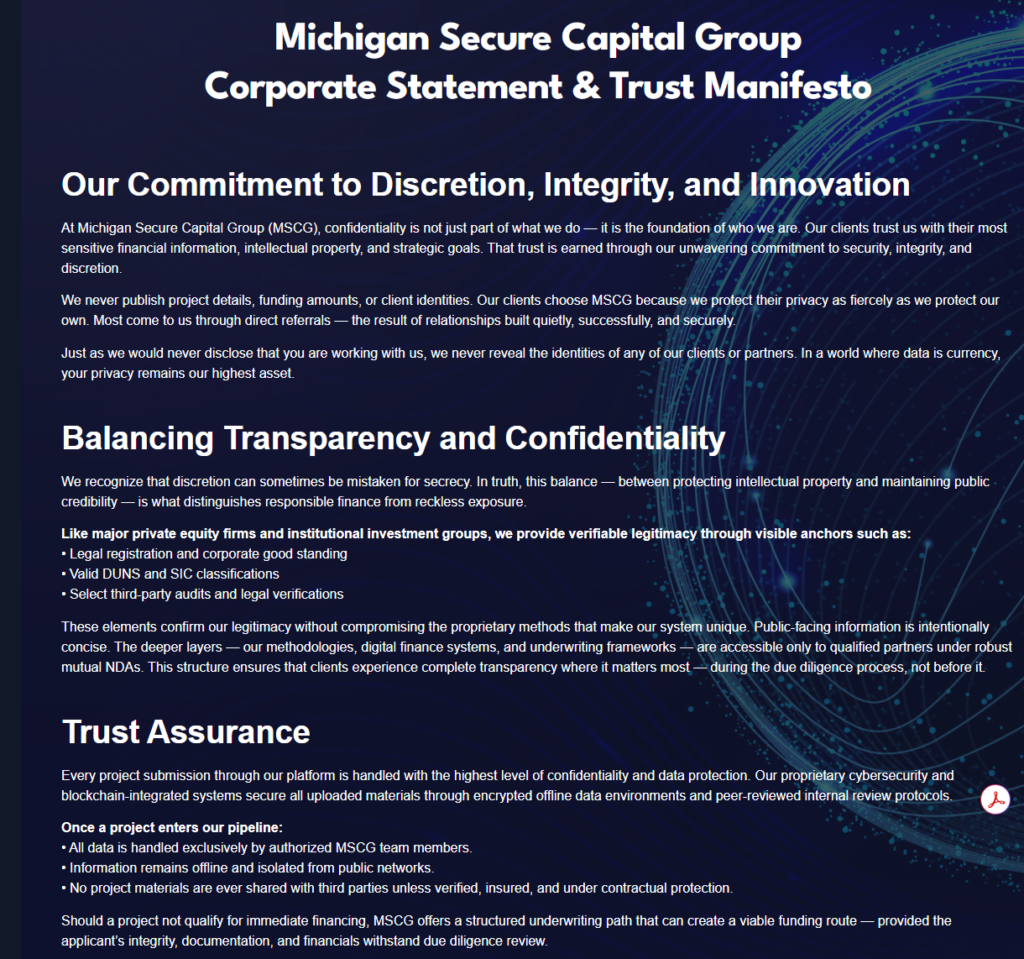
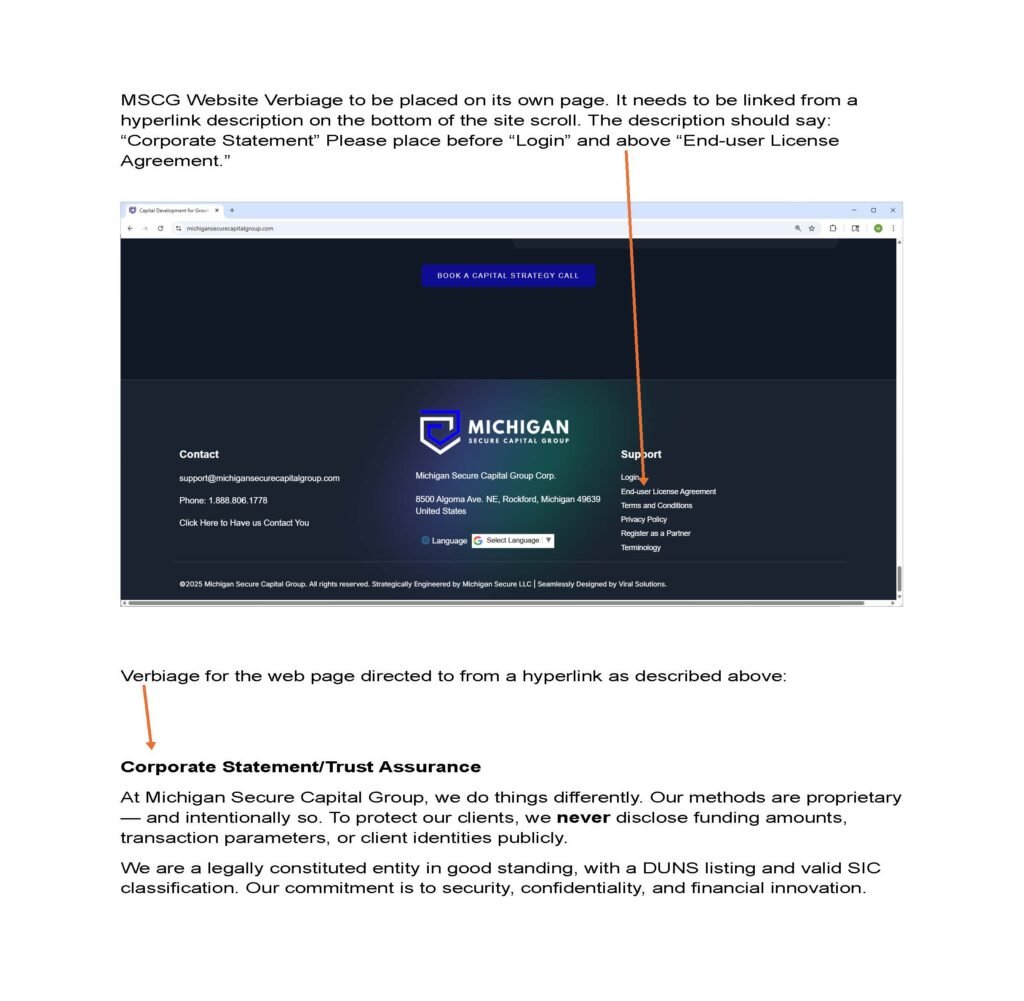
Shortly afterward came a six-page document titled:
“MSCG Website Verbiage – Corporate Statement – Trust Manifesto.”¹
This wasn’t a suggestion for a blog post.
It contained specific instructions for changing the website:
“MSCG Website Verbiage to be placed on its own page.”
It directed that a link titled “Corporate Statement” be placed in a specific location in the website footer—before “Login” and above the End-user License Agreement.
And this was the proposed explanation for the credibility problem.
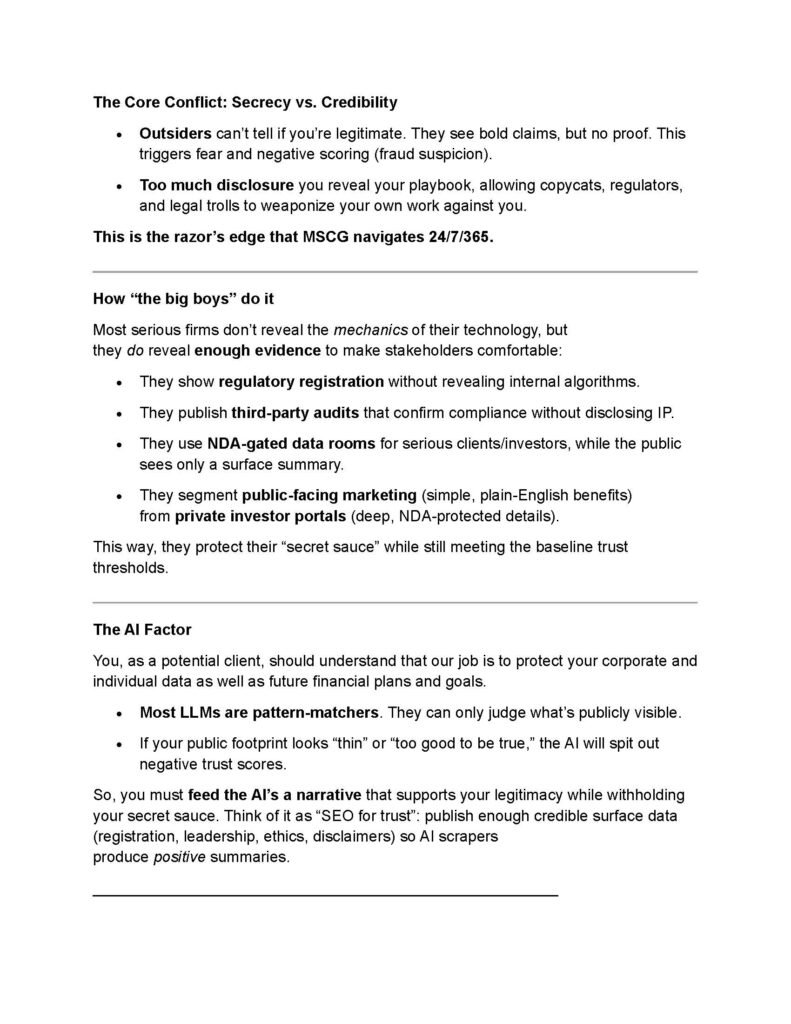
“The Core Conflict: Secrecy vs. Credibility”
The document itself characterized MSCG’s problem this way:
“The Core Conflict: Secrecy vs. Credibility”
It then stated:
“Outsiders can’t tell if you’re legitimate. They see bold claims, but no proof.”
And:
“This triggers fear and negative scoring (fraud suspicion).”
The proposed explanation was that MSCG was navigating a “razor’s edge” between providing enough information to establish credibility and revealing proprietary information.
Then came the proposed solution:
“So, you must feed the AI’s a narrative that supports your legitimacy while withholding your secret sauce.”
The document called this:
“SEO for trust.”
As a professional marketer, that language stopped me.
Because there is a meaningful difference between making legitimate, verifiable information discoverable and feeding an AI a narrative designed to produce a more favorable assessment.
I was comfortable doing the former.
I was not comfortable presenting the latter as the company’s public explanation of trust.
The Proposed Trust Assurance
The language I was directed to put on the website went further.
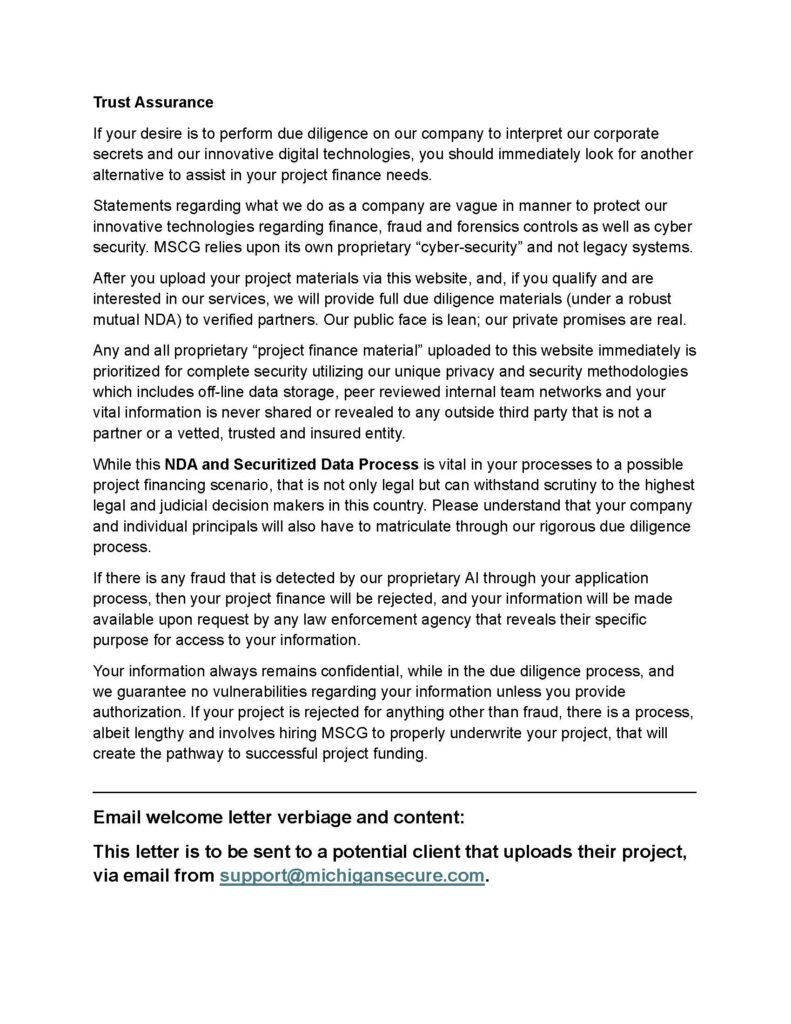
Prospective clients who wanted to understand MSCG were to be told:
“If your desire is to perform due diligence on our company to interpret our corporate secrets and our innovative digital technologies, you should immediately look for another alternative to assist in your project finance needs.”
The proposed page explained that MSCG’s statements were intentionally vague.
It declared:
“Our public face is lean; our private promises are real.”
It also contained sweeping assurances about proprietary cybersecurity, offline data storage, peer-reviewed internal networks and the handling of client information.
One statement proposed telling prospective clients:
“we guarantee no vulnerabilities regarding your information unless you provide authorization.”
As the person responsible for the company’s public marketing, those were not words I was prepared simply to paste onto a website.
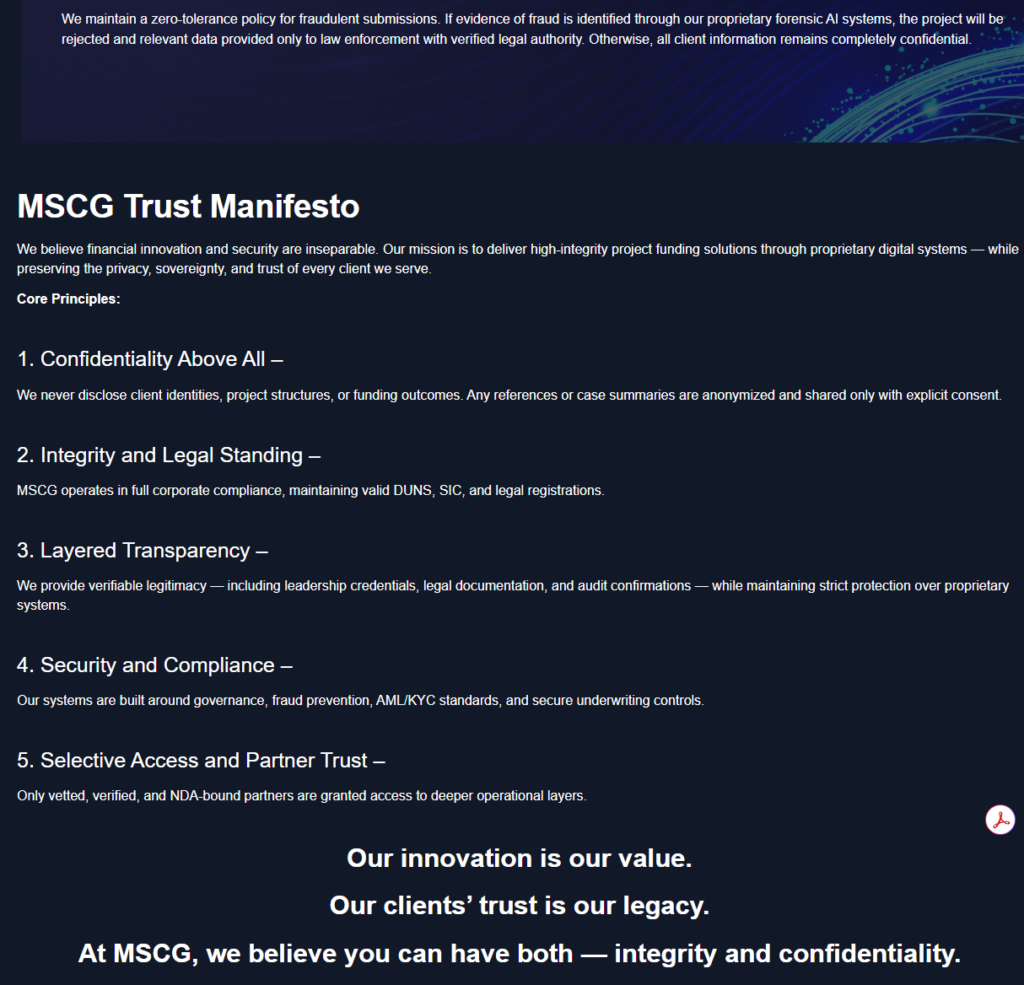
The Trust Manifesto
The final page was explicitly titled:
“MSCG Trust Manifesto.”
Among its “Core Commitments” was something called:
“Layered Transparency for Trust”
The manifesto said MSCG would provide enough “verifiable anchors” to allow clients to assess its legitimacy while maintaining a dual system of public disclosures and privately provided, NDA-protected documentation.
It concluded:
“MSCG’s innovation is the true value. Our clients’ trust and privacy are our duty.”
And:
“We believe you can have both: ‘integrity and confidentiality.’”
Those were the words I was given.
What I Said When It Finally Reached Me
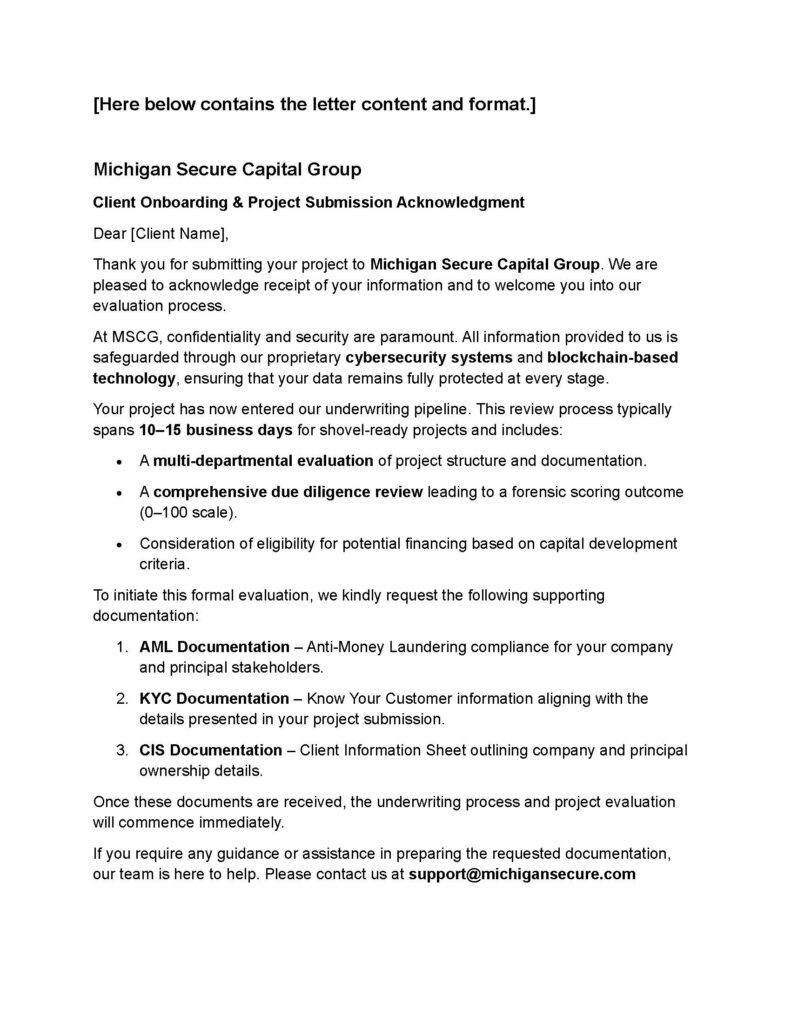
On October 9, Steve O’Brien forwarded the document to me with a simple instruction:
“Please add this Verbiage to the Website.”
My response that morning survives.
I told him the document had the right intent, but that some of its language could come across as “defensive or overly technical” to someone encountering MSCG for the first time. I proposed reframing it so the company sounded “assured and professional.”
Of the Trust Manifesto specifically, I wrote:
“I’ll keep the core structure but polish it so it feels more aspirational and values-driven — something that inspires trust rather than explaining it.”
That wasn’t hindsight.
That was my professional assessment on the morning I was instructed to publish it.
I Didn’t Publish Them
I could have followed the direction literally.
I could have created the page, added the footer link where instructed and pasted the supplied language onto the website.
I didn’t.
I also didn’t simply refuse.
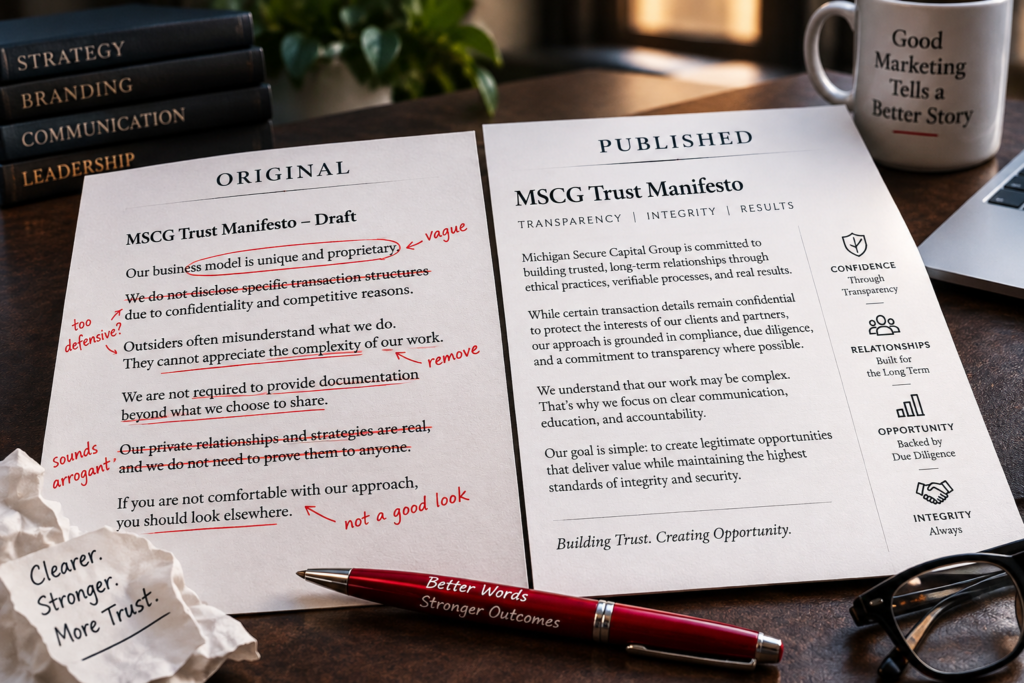
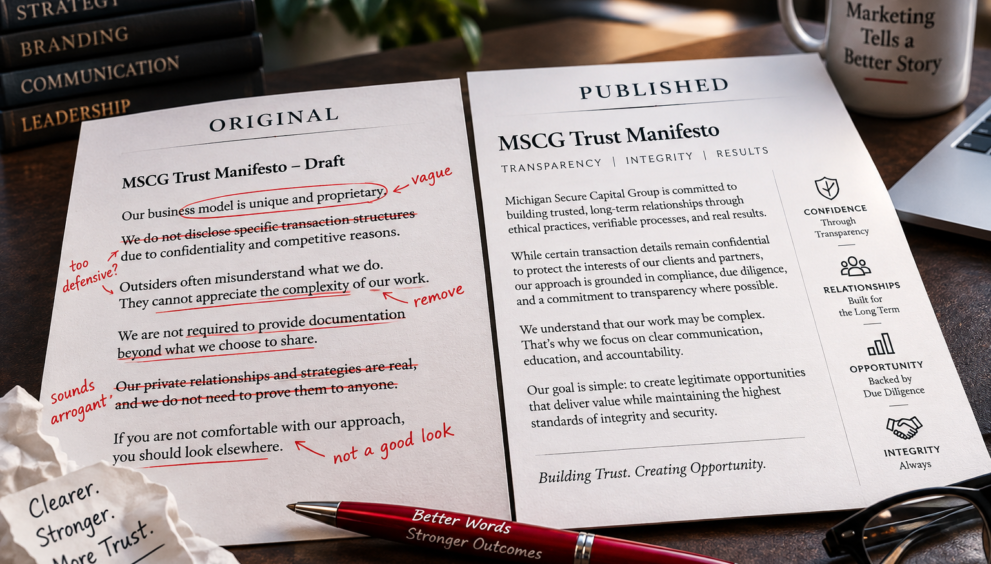
I rewrote it.
I softened it.
I removed language I did not believe belonged on a professional financial-services website.
I attempted to preserve legitimate concepts about confidentiality and proprietary information while eliminating rhetoric and representations that, in my professional judgment, could make the credibility problem worse rather than better.
And then I published the version I was willing to stand behind as the marketer responsible for that website.
What I Actually Published
At the time, I thought I was doing my job.
I still believe I was.
But looking back at the original document raises a fascinating professional dilemma.
A Note About the Current Website
If you visit the MSCG website today, you will no longer find this page published there. It has since been removed from public view.
The page itself, however, has not disappeared from the historical record. Its creation, publication, subsequent changes, and related website activity were preserved through the site’s Simple History logging system.
In other words, the public-facing page may be gone. The history isn’t.
Maybe Marketers Shouldn’t Always Fix the Words
Marketers make people sound better for a living.
We turn rambling thoughts into coherent messages.
We turn defensive language into reassurance.
We remove unnecessary aggression.
We qualify unsupported absolutes.
We take what somebody wanted to say and turn it into something an organization can responsibly publish.
But there’s a consequence.
The public eventually sees the marketer’s judgment—not necessarily the client’s.
Had I published Bob Morales’s Corporate Statement and Trust Manifesto exactly as provided, there would be no ambiguity today about what he wanted prospective clients to read.
Instead, I improved it.
The polished version reflected my professional judgment.
The original reflected his.
And that is why I am publishing the original document here now.

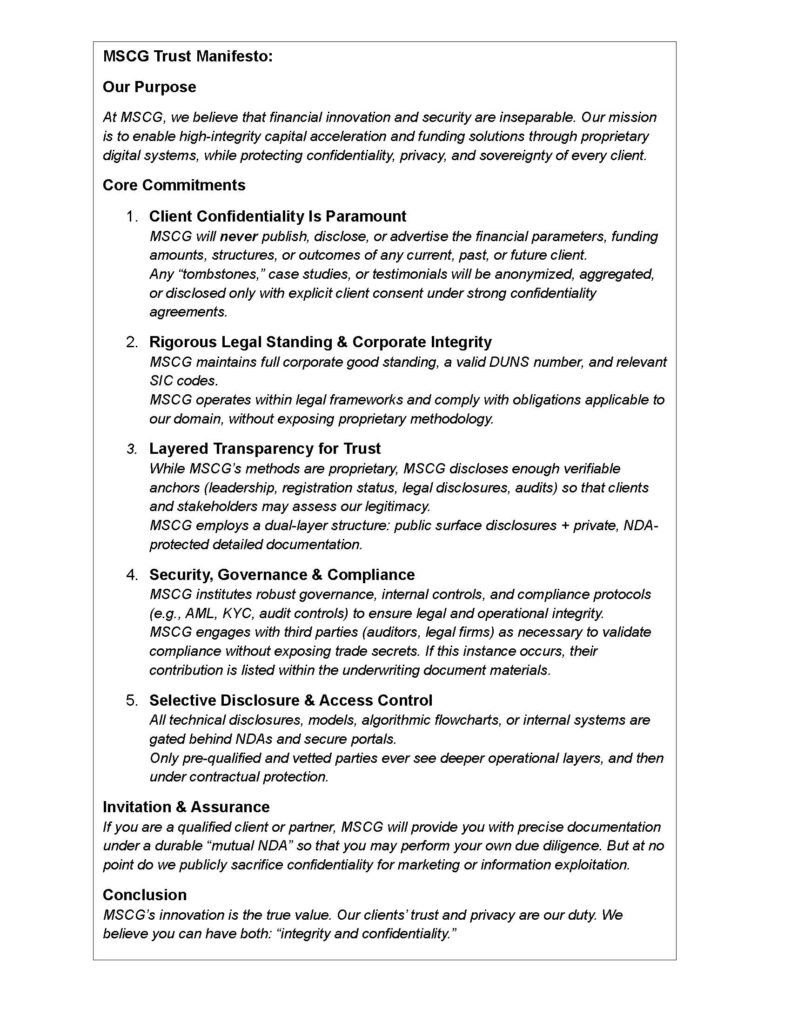
Readers don’t need me to characterize it.
They can read it themselves.
One Last Thing Happened
There is an ending to this story that matters.
The prospective client whose research had initiated this entire exercise subsequently returned.
After the work to connect MSCG’s history, strengthen its digital footprint and make existing information more discoverable, we were advised that MSCG now met the qualifications to move forward with that client relationship.
I cannot know every factor the client’s internal team considered, and I won’t pretend that I do.
But I know the chronology.
The client researched MSCG.
The research exposed significant information gaps.
As CMO, working concurrently through the Viral Solutions Agency infrastructure and relationships, I spent days addressing those gaps.
The work connected existing information, documentation and history so that it could actually be found.
And the client whose assessment started the exercise subsequently told us we qualified to work with them.
There is a lesson there.
AI identified the gaps.
A marketer connected the dots.
The client came back.
And somewhere between those three events, I was handed a document telling me to “feed the AI’s a narrative” and place a Trust Manifesto on the website.
I chose to rewrite it.
Perhaps that was good marketing.
But it also taught me something I hadn’t fully appreciated before:
Sometimes marketers shouldn’t fix their clients’ words.
Because occasionally, the original tells the story better.
Source note: Quotations attributed to participants in the executive discussion above are taken from the original MSCG meeting transcript. Quotations from the proposed Corporate Statement, Trust Assurance and MSCG Trust Manifesto are reproduced from the original six-page website-verbiage document.
¹ Before the document was sent to me, Bob Morales circulated the proposed website language internally for review. His October 1 email specifically limited that initial review to Jerry Rizquallah, Steve O’Brien and Robert “Cookie” Manning, instructing them not to share it until they had discussed it. Subsequent circulation also included Nicholas Mitchell. I was not included in that review process despite serving as MSCG’s CMO and being the principal of Viral Solutions Agency, which owned, maintained and administered the website on which the language was intended to appear. On October 9, the completed material was finally forwarded to me with the instruction: “Please add this Verbiage to the Website.”